
The Business Is Ready to Expand Abroad. Who Will Take the Decisions?
International expansion looks like a market and execution question. It is really a governance one - how ownership, authority, capital and decision-making must change as a domestic business turns global. This memo considers the governance questions worth addressing before truly going global.


A promoter-led business can spend years building a strong position in India.
The promoter knows the customers. The leadership team knows how decisions get made. The family understands who is responsible for what. The board-if there is one-knows when to challenge and when to trust management.
Then an opportunity comes from outside India.
A customer wants a local presence. An acquisition becomes available. A foreign partner wants to invest. A subsidiary is proposed in another jurisdiction. The next generation sees a larger global opportunity.
The business begins preparing for international expansion, and the usual questions arrive quickly:
- Which country should we enter?
- Should we establish a subsidiary, acquire an existing business or work through a local partner?
- How much should we invest?
- How should the overseas business be funded?
- Who should lead it?
These are important questions. But another question often arrives later than it should:
Is the way we govern the business ready for what is about to change?
Going global does more than add another geography. It changes the context in which ownership, authority, risk and judgment operate.
The decision now has two centres
A ₹300 crore Indian business with one promoter family, a familiar management team and operations largely within India can function with a relatively concentrated decision-making model. The promoter may still approve major investments, key hires, borrowing, customer commitments and strategic relationships personally.
That model becomes harder to sustain when the enterprise has an overseas subsidiary, foreign customers, local management, international lenders, multiple currencies, a joint-venture partner or operations subject to another regulatory environment.
A country manager needs authority to respond to the market. An overseas board may need to take decisions locally. The CFO must manage currency, funding and treasury exposure. The Indian board needs visibility over risks it cannot observe directly. The promoter family must decide how much control it wants to retain as the enterprise becomes more international.
The business has crossed a border. Its decision-making cannot remain entirely on one side of it.
Governance is not a meeting calendar
Most established promoter-led businesses already have governance. They have directors, auditors, statutory processes, management meetings and approval routines. The question is not whether governance exists. It is whether governance is designed for the business that exists today.
A system that worked when the company had one location and ₹100 crore of revenue may become inadequate when the enterprise has five jurisdictions, larger capital commitments and decisions being made several time zones away.
This does not necessarily mean more committees or more meetings. It means greater clarity around a few basic questions:
- Who decides?
- Who approves?
- Who is accountable?
- What must come back to the board or promoter group?
- What can management decide independently?
- What information does each decision-maker actually need?
International expansion exposes ambiguity quickly. A local leader who has responsibility without authority will wait for India. A parent company that gives authority without information will discover risk too late. A family that has not discussed leverage or dilution may find itself debating ownership in the middle of a transaction.
The founder’s judgment must travel
Founders often develop a remarkable instinct for risk. They know which customers are dependable, which partners are genuinely committed and which attractive proposal does not feel right. That judgment is one of the reasons the business has succeeded.
But a global enterprise cannot depend on one person personally knowing every market, regulator, customer and local management team. Nor can it wait for the founder to understand everything before acting.
The transition is not from founder judgment to no judgment. It is from concentrated judgment to distributed judgment-with clear boundaries, reliable information and escalation when the stakes require it.
That is a deeper form of institutionalization. The founder’s experience becomes principles, decision rules, people and forums that can operate beyond the founder’s physical presence.
What should change first?
There is no universal governance model for a promoter-led business going global. A ₹200 crore family-owned manufacturer entering one overseas market does not need the structure of a listed multinational. But several areas deserve attention before the expansion becomes significant.
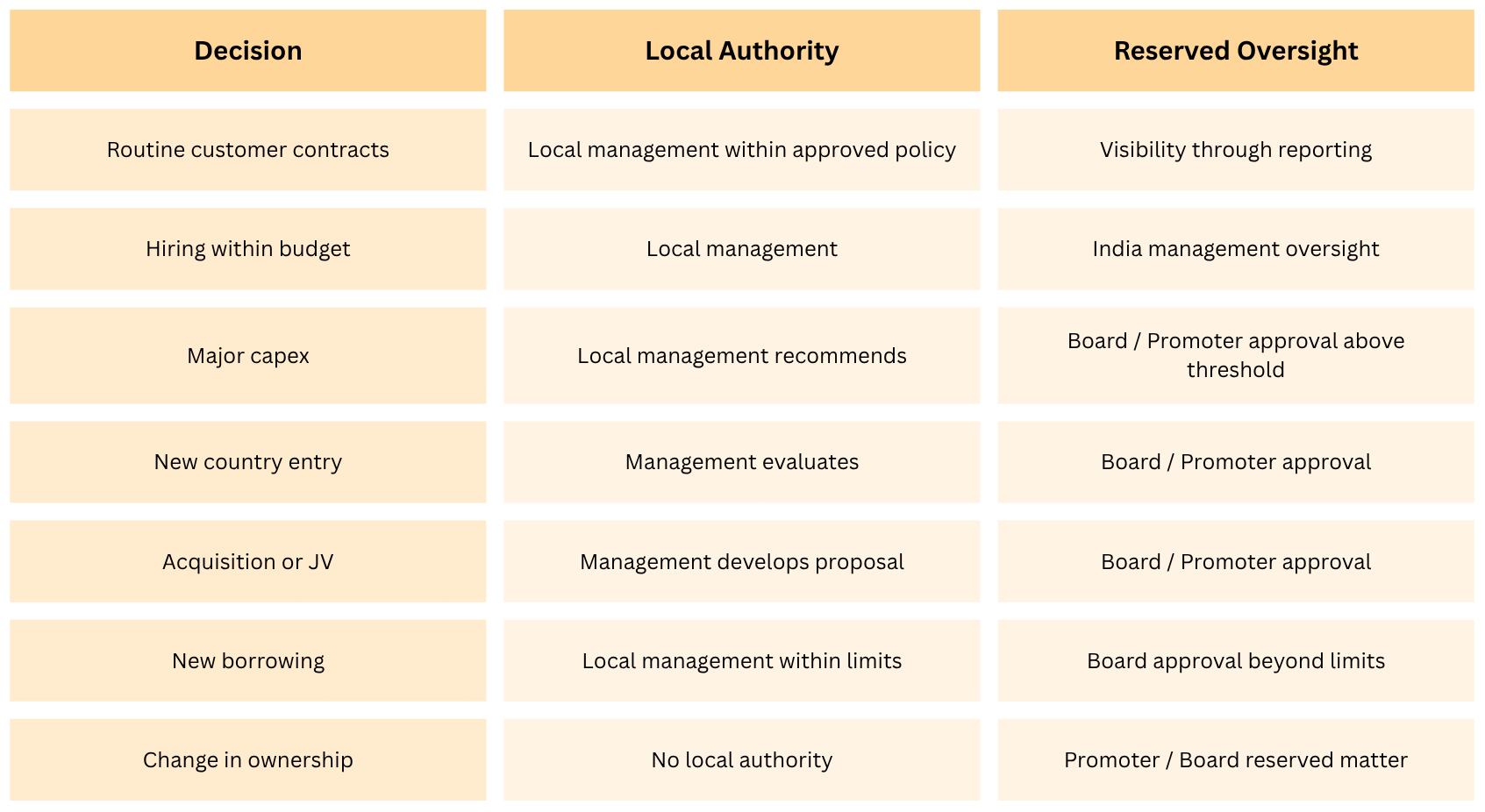
1. Decision rights
The first question is basic: which decisions can overseas management take without coming back to India?
The thresholds will differ from firm to firm. The principle should not: authority should sit as close as possible to the decision, with clear boundaries and escalation routes.
2. Board visibility
A board cannot govern an international business through quarterly surprises. It needs a common view of country-level performance, capital deployed, cash generation, debt, currency exposure, regulatory issues, key people, customer concentration, related-party transactions, litigation and partnership risk.
The question is not how much information can be produced. It is what information allows the board to make a better decision. A short, consistent international dashboard is often more useful than a large pack that no one reads.
3. Local leadership
International expansion often weakens through leadership ambiguity. The wrong local leader is appointed. The local team cannot make decisions. India keeps overriding local judgment. Or the overseas business becomes disconnected from the parent’s priorities.
A promoter should ask: what authority will the person running this market actually have?
Giving someone a title without decision rights is not delegation. It is only a change in designation.
4. Risk and capital discipline
Cross-border growth adds risks that may not be visible in the domestic operating model: foreign-exchange exposure, funding mismatches, local compliance, tax and transfer-pricing positions, sanctions or trade restrictions, data and employment rules, partner dependence and repatriation constraints.
The response is not to make every decision central. It is to define which risks require common standards across the group and which can be managed locally. Governance should make risk visible early enough for judgment to matter.
Ownership becomes more complicated
A promoter may initially think: “We are simply setting up an overseas subsidiary.” Over time, other possibilities emerge. A foreign strategic partner may want an equity stake. A local management team may become important enough to participate economically. An acquisition may require external financing. A private-equity investor may become interested in the broader group. The family may want to ring-fence certain assets.
The question then moves beyond incorporation:
What ownership structure best supports the enterprise we are trying to build?
That decision affects control, dilution, capital, governance, tax, family expectations and future liquidity. It should not be left to the technical execution stage after the strategic choice has already been made.
Global growth can expose family differences
International expansion can turn quiet family differences into visible ownership questions. One family member may support aggressive investment; another may prefer dividends and lower leverage. One may lead the overseas business; another may remain a passive owner. A third may want liquidity rather than a larger operating role.
These differences may remain manageable when the business is concentrated in India and the promoter remains closely involved. They become more consequential when capital is deployed across jurisdictions and the enterprise becomes harder to observe directly.
The family should therefore discuss risk appetite, reinvestment versus distributions, leverage, ownership dilution, geographic ambition, future liquidity, next-generation involvement and the founder’s evolving role before the next decision becomes urgent.
A practical readiness test
Before entering a new country, I would ask the promoter group to imagine that the overseas business becomes three times larger than expected.
- Would the current decision rights still work?
- Would the promoter still need to approve most important decisions?
- Would the board have enough information to challenge management?
- Would the local CEO have sufficient authority?
- Would the family agree on the next investment or capital call?
- Would the ownership structure still make sense?
- Would the firm know where value is actually being created?
- Would the structure withstand scrutiny from an institutional investor five years from now?
These questions can reveal more than a detailed expansion plan. They test whether the institution is ready for the enterprise that success may create.
Governance should enable ambition
Entrepreneurs sometimes worry that stronger governance will make the business slower. That happens when governance becomes a collection of approvals.
Good governance should do the opposite. Clear decision rights allow capable people to act. Better information allows the board to focus on significant issues. Aligned family expectations make capital decisions easier. A clear mandate allows local leadership to pursue opportunities without waiting for India to resolve every detail.
The objective is not more governance. It is governance designed for the scale, geography and complexity of the enterprise.
A Counsel’s View
I increasingly see international expansion as a test of institutional maturity in promoter-led businesses.
A business can have an excellent product, strong customers and sufficient capital to invest-and still be governed in a way designed for an earlier stage of its journey.
The opportunity to go global is therefore also a governance checkpoint. Before asking whether the business can expand abroad, promoters should ask whether the institution is ready to govern what that expansion will create.
The strongest global businesses are not necessarily those with the most elaborate governance structures. They are the ones where ownership is clear, authority is appropriately distributed, information reaches the right forum and people know what they are accountable for.
That is what allows entrepreneurial energy to travel across borders without requiring the founder to travel with every decision.
One question worth reflecting on
If the business becomes twice as international over the next five years, which decisions would you still want to make personally-and which decisions should the institution already be capable of making without you?
The answer may tell you more about readiness for global expansion than the size of the opportunity itself.
Continuing the Conversation
The Ownership & Capital Memo is a bi-weekly series on the decisions that shape enduring enterprises across ownership, capital, governance and continuity.
If this edition resonates with a situation your business, family or promoter group is currently navigating, I would be pleased to exchange perspectives through a confidential discussion.
MEGHNAND DUNGARWAL
Independent Strategic Counsel to Promoters
Founder Transition • Succession
Ownership, Governance & Capital Decisions | Cross-Border
SHOONYAS INSTITUTIONAL COUNSEL
Judgment at Inflection Points