
Half the Owners Are Here. Half Are Abroad. Whose Business Is It, Really?
This memo examines what changes when the people who own a business no longer live in one place, and the four decisions that keep distance from turning into a dispute.

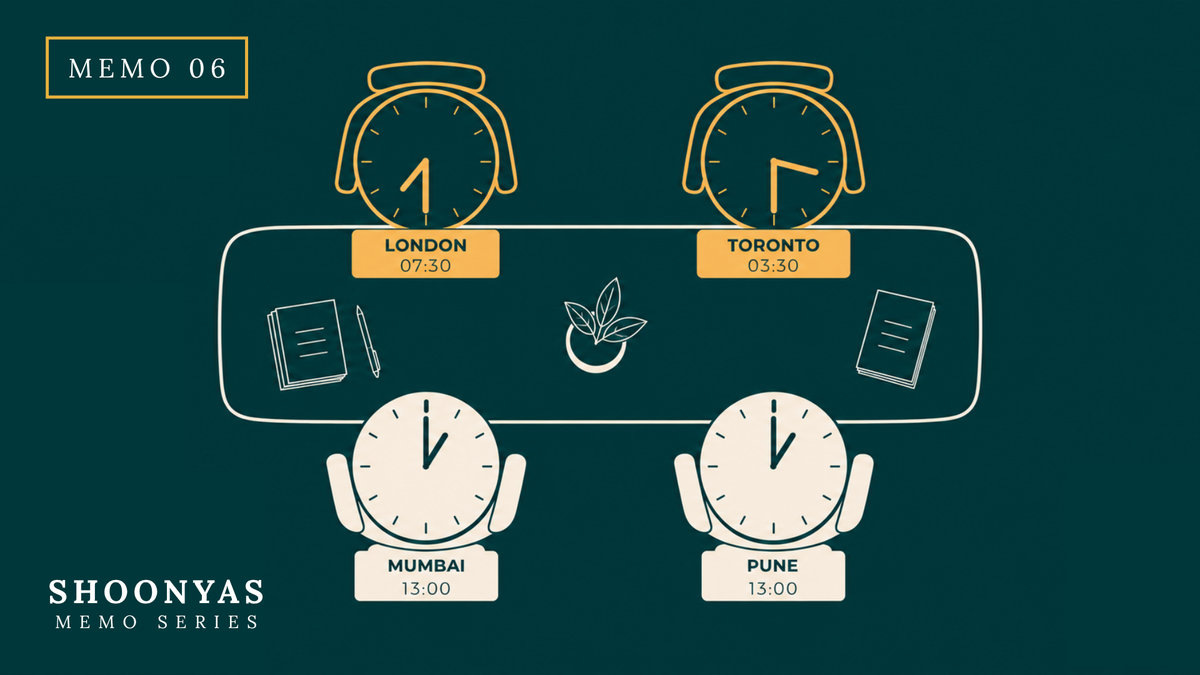
Consider two businesses.
The first is a ₹250 crore family-owned manufacturer. The founder is 63 and still at the plant every morning. His elder son runs sales. His daughter lives in London and his younger son in Toronto. Both hold shares. Neither works in the business.
The second is a ₹150 crore professionally run services firm owned by nine partners. Most of them work from the home cities. One moved to Singapore for his children's schooling. Another plans to retire to Dubai within three years.
Different structures. The same quiet question.
When the owners no longer live in the same place, whose business is it, really?
Distance separates ownership from involvement
When every owner lived within an hour of the office, ownership and involvement were the same thing. Owners knew what was happening because they were there. The Sunday lunch, or the partners' Friday call, did the work of a board meeting. Nobody had to ask.
Distance removes that. Ownership stays. Involvement goes.
The pattern is common. HSBC's 2025 survey of high net worth business owners across ten markets found that 79% of the Indian respondents plan to pass the business to family, the highest share of any market. However, about 45% do not expect their children to take it over.
Ownership is staying in the family. Operations are not always following.
In a professionally run business the gap opens differently. A co-founder relocates. A partner approaches retirement. An investor sits in another country. The title says "owner". The calendar says "visitor".
The owners at home keep running the business. The owners abroad keep owning it. Between them opens a gap, and a gap fills with assumptions.
Those at home assume the owners abroad have stopped caring. Those abroad assume they are being kept out of the loop.
Both are partly right. Neither has been asked.
Distance does not change who owns the business. It hides what each owner wants from it.
A say, an income, an exit, or a way back
Owners who live elsewhere rarely want the same thing. Broadly, each wants one of four.
- A say. To be consulted on the big decisions, even if they never attend a meeting.
- An income. Distributions that are predictable and fair.
- An exit. To turn a share into money, on fair terms, without a quarrel or a forced sale.
- A way back. To return to a role one day, and to know the door is still open.
Four different wishes. Four different answers. A business that treats them as one, usually "we will keep them informed", satisfies none of them.
The same four appear in a family and in a partnership. The daughter in London may want an income. The partner in Singapore may want a say. The partner heading for Dubai may want an exit. The younger son in Toronto may one day want a way back.
Does the owner at home know which is which?
What it costs to leave it unsaid
The cost is rarely a dramatic quarrel. It is slower than that.
Decisions are taken at home and explained afterwards. The owners abroad accept them, then resent them. Or a decision waits for one signature that is two time zones away. Or a good offer arrives, and the owners discover, in the middle of it, that they do not agree on whether to sell.
Meanwhile the leadership team, family or not, is watching. They notice who is consulted and who is not. They notice when the answer depends on who happens to be in the room.
The best of them draw their own conclusion about how long the business will be run this way.
Three moments tend to force the question: someone announces a move, an offer arrives, or someone falls ill. A conversation held under those pressures is rarely a calm one.
Four decisions to settle while everyone is still talking
- What needs every owner's consent. A short list, not a long one: selling the business, issuing new shares, large borrowing, changing the leader. Everything else belongs to the leadership team. A short list protects those abroad without paralyzing those at home.
- What every owner receives, and when. Money: a stated rule for distributions, so nobody has to ask. Information: the same one-page report, on the same day, to every owner. And one annual meeting, timed so that nobody joins at 3 a.m.
- How an owner leaves. An agreed route out: who may buy, how the price is set, over what period. Agree the principle now. The lawyer drafts it later.
- How someone returns. A stated route back into a role: what qualifies, who decides, what the owner at home gives up. In a partnership, whether a partner who relocated can step back into leadership, and on what terms.
Each answers one of the four wishes. None is a legal document yet. Each is a decision, and the document comes second.
Back to the two businesses
In the manufacturer, the answers might look like this. The daughter in London takes a steady distribution and a place at the annual meeting. The younger son in Toronto is told, in writing, what it would take to join. The founder and his elder son keep a short list of decisions that need all four of them.
In the firm, the partner in Singapore keeps his vote on that short list and receives the same monthly page as everyone else. The partner retiring to Dubai agrees today how his share will be bought out over three years.
Nobody had to move back. Nobody had to be pushed out. They only had to be asked.
A test you can run this week
- Can each owner say what every other owner wants from the business?
- Is there a written list of decisions that need every owner's consent, and is it short?
- Do all owners receive the same information on the same day?
- If one owner wanted to leave next year, is there an agreed route, or would it begin a negotiation?
- If the owner at home were unavailable for ninety days, would every owner abroad know who decides?
If most of the answers are "no", the gap is already filling with assumptions.
A Counsel's View
Most owners reach for structure first: a holding company, a trust, a new entity abroad. Structure has its place. It belongs with the chartered accountant and the lawyer, and the rules differ by country and by where each owner lives.
But structure comes second. A trust deed cannot tell you what your daughter in London wants from the business. A partnership agreement cannot tell you whether the partner in Singapore expects to return.
Structure follows the decision. It cannot replace it.
I would begin elsewhere. I would ask each owner, separately, the same question: do you want a say, an income, an exit or a way back? Then I would put the answers side by side.
Differences that have stayed hidden for years appear with clarity. And what the owners decide can then go to the lawyer as a clear mandate, not an open question.
The question to take into your next meeting
If you asked every owner, separately and on the same day, what they want from this business over the next ten years, how many different answers would you hear?
Continuing the Conversation
If this question is already in the room, in your family or among your partners, I would be pleased to exchange perspectives through a confidential discussion.
Meghnand Dungarwal
Independent Strategic Counsel to Owners & CEOs | Advising on Ownership, Governance, Succession & Legacy Decisions | Across Borders
SHOONYAS INSTITUTIONAL COUNSEL